

Across Kenya, Nigeria and Senegal, young Africans are quietly confiding in AI chatbots about heartbreak, stress and depression. New exploratory research from YUX looks at why, and at the cultural and religious forces shaping how the continent approaches mental health.
A companion at 3 a.m.
When Grace, a Kenyan woman in her late twenties, was left by her partner shortly after giving birth, she found herself alone with a newborn and no one to lean on. Depression set in. With nobody to talk to, she opened ChatGPT looking for relationship advice. What she found was companionship, practical coping strategies and a renewed sense of self-confidence.
"AI was always there to give advice on how to fight loneliness and always kept me company. AI was also giving out words of encouragement."
Grace's story was one of many shared with us through our survey. Stories like hers are becoming more common, yet there is almost no coverage of how Africans use AI for mental health. We set out to change that.
Interest in mental health has grown steadily since COVID-19, and people around the world are now turning to conversational AI for support. The appeal is easy to see: chatbots are always available, mostly free and completely anonymous. But the risks are real too. Tragic cases such as that of Adam Raine, a US teenager whose death was linked in media reports to his conversations with a chatbot, have shown the dangers of confiding in tools that cannot truly grasp the human experience.
Is AI good or bad for mental health? The debate is heated - and, as so often, it happens with very little data about African users. Conversations within our own team after the pandemic led us to a simple question: how are Africans actually using AI chatbots for their mental wellbeing? This article shares what our exploratory research found.
How we did the research
We combined expert voices with first-hand accounts from users.
Expert interviews. We interviewed a dozen professionals in Ghana and Senegal, including psychiatrists, psychologists and an imam. Our Ghana-based researcher, Sasha Oseadeyo Ofori, also attended a mental health conference in Accra, which shared key data on the state of mental health in the country.
An online survey. We then ran a survey in Kenya, Nigeria and Senegal. We had planned to include Ghana, but the social media tool we used to distribute the survey could not reach Ghanaian audiences.
We collected 525 validated responses:
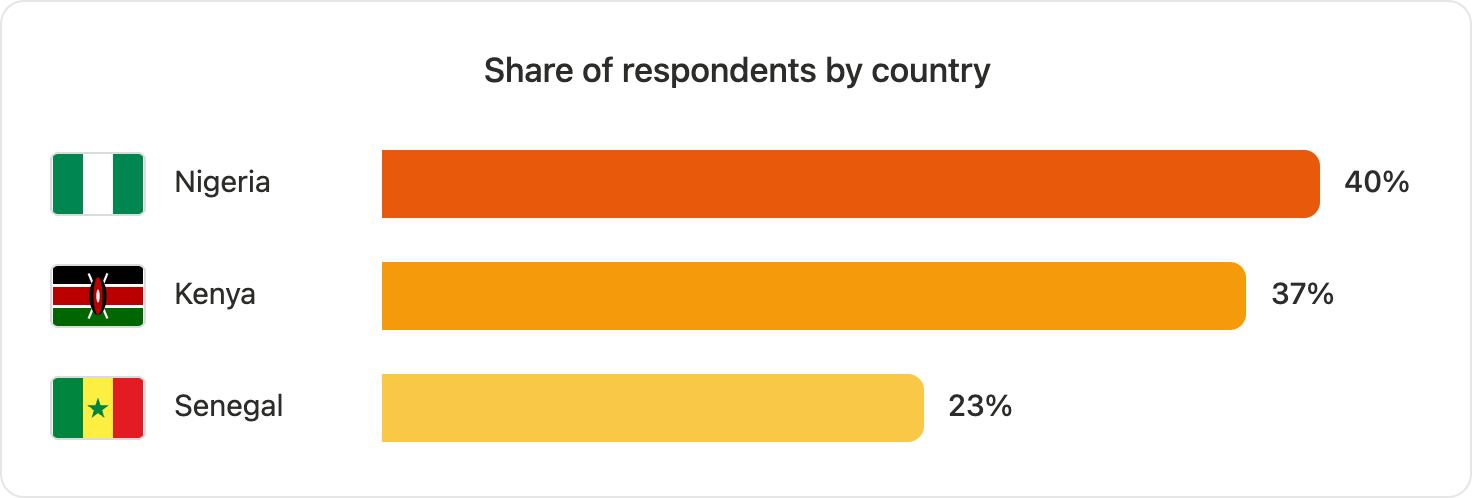
Respondents were 58% male and 42% female. They were also disproportionately young, digitally connected and educated: 92% had attended college, university or postgraduate studies.
A note on limitations. Because the survey was conducted online, it excluded less connected populations. People who choose to respond to a survey on mental health are also likely to have more knowledge of, experience with, or interest in the subject. Our sample is therefore not representative. Even so, this exploratory work offers valuable insights for anyone working in the field, and the comparisons between countries are especially revealing of cultural differences.
Why getting help is so hard
Our expert interviews confirmed what we suspected going in: professional care is scarce and expensive. But the deepest barriers are cultural, not financial.
Too few professionals, too high a price
The continent faces a severe shortage of trained mental health professionals. Not every country offers a path to qualify, or recognised diplomas. Senegal, for example, only recently opened a course at Université Cheikh Anta Diop (UCAD), and no class has graduated yet. Every professional we spoke to there had trained abroad.
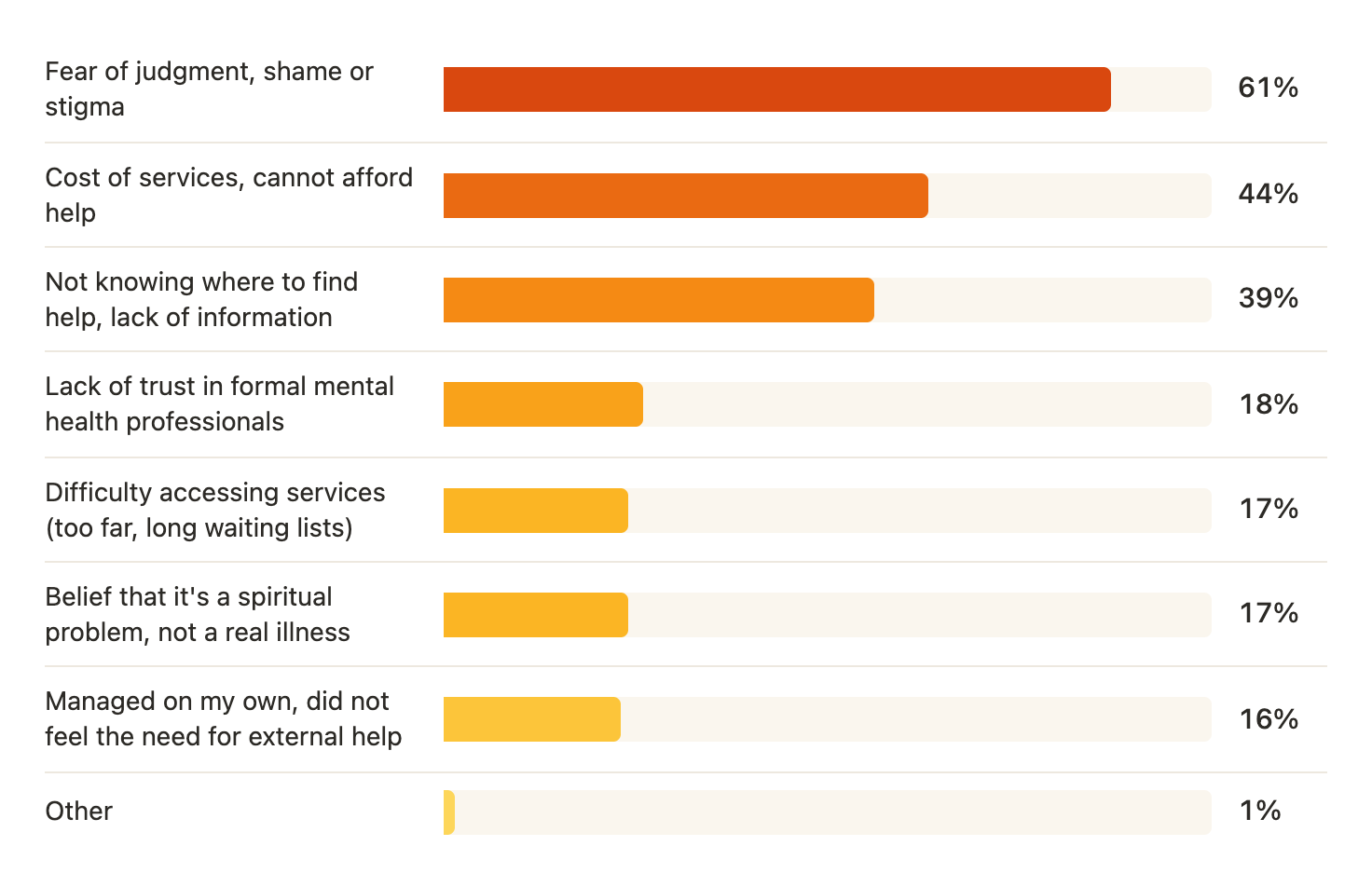
Where care exists, it is costly: a session can cost roughly a week's salary for someone on an average income. This puts treatment out of reach for rural and financially vulnerable people, who make up the majority of the population. Among respondents who had experienced a difficult mental health episode without seeking professional help, 44% named cost as the main barrier.
What are the biggest challenges for seeking support for a mental health issue?
Stigma: the biggest barrier of all
Stigma ranked as the single most important obstacle, cited by 61% of respondents. Much of it stems from confusing mental health with mental illness: a quarter of our respondents (25%) associated "mental health" with "madness" or "mental illness". In a representative sample, we suspect that figure would be far higher.
The professionals we interviewed described a heavy silence around emotional struggles. A clinical psychologist at Hopeful Nkomo, a Ghanaian mental health non-profit, explained that admitting you are unwell implicates not just yourself but your whole family. In some regions, it can even affect marriage prospects: "Would anyone marry me because of my mother's condition?"
The consequences for those affected can be severe:
"People feared that if you interacted with mentally ill people, you would become mentally ill. They would take them out of town and keep them in seclusion, tie them in chains, and beat the evil spirits out of them." - Clinical psychologist Hopeful Nkomo
A clinical psychiatrist at Korle Bu Teaching Hospital in Accra described how conditions are often reinterpreted in spiritual terms. Depression is seen as a lack of mental strength, sometimes attributed to demons. Many people cannot distinguish anxiety at all. Schizophrenia is viewed as a spiritual attack, and bipolar disorder as a cyclical spiritual attack. Families often prefer prayer camps and spiritual solutions to medication, also partly out of fear of side effects.
When people cannot name what they feel
In some cultures, children learn early to "grin and bear it", not to complain and not to cry. As psychologist Mme. Dumont, an expert in Senegal, put it, many people find it hard to recognise or accept that they are under mental strain. Mental health can also feel too abstract: health is often associated with the body, so psychological distress is sometimes attributed to "phantoms". In these cases, the barrier arises even before the decision to seek help.
There are signs of change. As one Ghanaian expert noted, COVID-19 sparked a real shift in favour of mental health awareness.
Where people turn instead
Experts and survey respondents agree: the first reflex is to turn to family. This keeps problems private, but it is far from ideal, since many mental health issues originate within family relationships.
Religion comes next. For many, prayer, faith and religious communities are a genuine source of strength. "Those who believe in something are able to cope better," one psychologist told us. But she also warned that some unregulated "churches" need scrutiny, as they can take advantage of people in vulnerable situations.
AI as a confidant: what we found
The short answer is yes. Africans are using AI chatbots for mental health support. Eighty-six percent of our respondents said they had used ChatGPT. Some also mentioned dedicated global mental health apps, such as Woebot and Wysa, which are designed specifically to support mental health.
Why AI? Anonymity, availability, no judgement
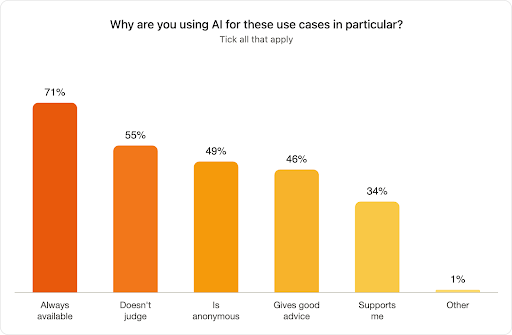
The reasons respondents gave align closely with the barriers described above. A chatbot is anonymous, so there is little risk of information reaching family or community members. It is available at any hour, often at little or no cost. It also offers no judgement, which can be especially appealing in societies where admitting distress carries significant stigma.
“I have a friend that was so depressed, we are of the same age and I couldn't offer proper guidance to him. He kept on asking me how can he change his situation for the better because all his efforts was not yielding any results. My experience using ChatGTP for almost all my problems was what I recommended he try. He decided to use AI to get help on how to redirect his life and make things better. Aside the church, AI has become his best companion to ask any questions, in fact questions he can't even ask in church because of fear of being judged, and I can see improvement .” - Kenyan participant
Four trends worth watching
1. AI as a gateway to professional help. For some respondents, conversations with a chatbot helped them realise they were experiencing a depressive episode, and several subsequently sought professional support. More controversially, some said AI helped them self-diagnose certain health issues, a practice that deserves closer investigation.
“I was having anxiety disorders. I didn't realise I was having one until I used the AI to understand what I could be feeling. When I checked in with the doctors, it’s true I was suffering from mild anxiety disorders. I was administered Adderall, and it helped big time. Though it’s an addictive drug.”
2. Simple advice that makes a real difference. Chatbots often suggest basic steps: sleep more, exercise, eat well. Many users told us this advice helped them a great deal. That raises an important question: does it reveal how little everyday support people have in thinking through these basics?
“There was a time when I felt guilty about everything that happened to me, and it was eating me up inside. I couldn’t talk to anyone because I felt like they wouldn’t understand me. So, I opened up to ChatGPT, and it helped me clearly understand that none of it was my fault. It understood me and also gave me advice. I felt so relieved ”
3. A safe place to vent about relationships and family. This came up again and again. Relationships with parents and heartbreak were two of the most common reasons respondents gave for turning to AI.
“At some point in life I was so depressed due to family issues and parents fights back at home, Chat GPT offered me advices on relaxation techniques and helpline numbers for self help which helped me a lot”
4. Coping with work stress. Work was another major source of stress that people confided to AI. Here, respondents generally found the chatbot's recommendations genuinely helpful.
“A friend was dealing with burnout but didn’t want to open up to anyone at work. She started using an AI in the evenings to talk about her day and practice mindfulness. The app helped her notice how much stress she carried from meetings and gave her short breathing exercises. After a few weeks, she felt lighter, started setting boundaries, and said the AI tool helped her catch the signs of burnout early. It really helped her get through the hard times. “
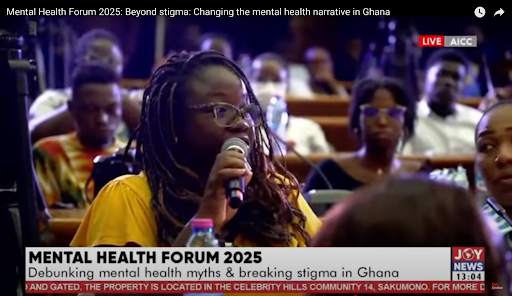
Sasha Oseadeyo Ofori, of YUX, at the mental health Forum in Accra, Mai 2025, as captured by the live stream held at the event.
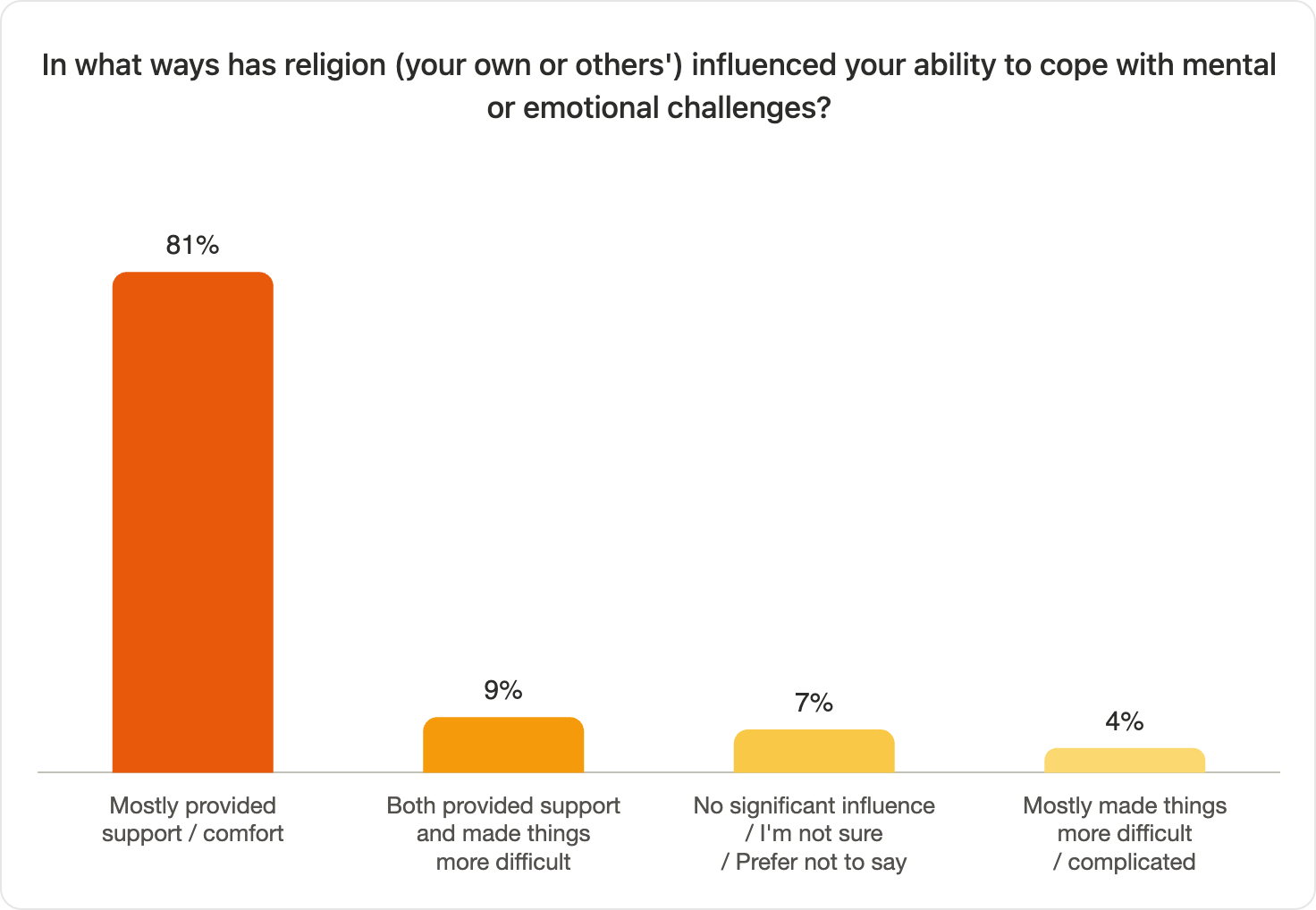
Faith and culture: a double-edged sword
One of our most striking findings is that culture, not religion, drives the differences. Christian and Muslim respondents answered in similar ways, while Nigerian and Kenyan respondents differed noticeably from one another. Attitudes towards mental health varied far more by country than by faith.
In Ghana, many people follow a "dual pathway" to healing, combining prayer and spiritual interventions with visits to hospitals or clinics, sometimes one after the other and sometimes at the same time.
Religious narratives shape how whole communities see mental illness, for better and for worse. Some teachings reinforce stigma by framing mental illness as the result of sin, weak faith or spiritual failure. Participants at the Accra forum even noted that some church songs can deepen feelings of sadness, a reminder of the power of music. At the same time, a growing number of faith leaders are preaching compassion and acceptance, and encouraging people to seek professional help.
As the imam we interviewed put it:
"Religious leaders translate the divine to the mortal. This can lead to positive and negative interpretations which can affect how mental health is treated. More positive interpretations will suggest seeking mental health assistance, while negative ones might encourage internal and external stigmatisation."
What this means
AI chatbots are filling a gap that Africa's health systems and social norms have left wide open. They offer what professional care often cannot: anonymity, constant availability and freedom from judgement, often at little or no cost. For people like Grace, that can mean the difference between facing a crisis alone and finding a first foothold.
“At a desperate point, when a friend was almost jumping off a roof, she engaged with AI, poured out her heart and felt some relief.”
But AI is not a therapist. It cannot replace trained professionals, and it carries real risks for vulnerable users. The opportunity lies in using it well: as a gateway that helps people recognise what they are feeling, reduces the shame associated with talking about it and points them towards human support, whether that is a clinician, a trusted community member or an informed faith leader.
Achieving that will take more than technology. It will require investment in training professionals, public awareness that separates mental health from "madness", and partnerships with the religious and community leaders who shape attitudes every day. It will require training models to contextualized advice, such as this participant stated she received:
“I lost my phone some months ago, I became so depressed, I waited long to have that phone. I would use my sister's phone to ask ChatGPT if maybe God was angry with me that was why he allowed my phone to be stolen and chatGPT would offer me some encouraging words and biblical scriptures”
But it will also require more research: this study is only a first step, and we hope it encourages others to look closely at how African users experience these tools.
If you are struggling with your mental health, please reach out to someone you trust or to a local mental health service.
This research was conducted by YUX. We thank the psychiatrists, psychologists and religious leaders who shared their expertise, and every respondent who shared their story with us.
Author: Camille Kramer-Courbariaux
AI disclaimer: AI tools were used to support editorial refinement and the visual styling of graphs. The author reviewed, revised and approved the final article and remains responsible for its content. Graph data was generated using the LOOKA platform.